League Operations
Ohio Youth Coach Concussion Training: What Leagues Need
Ohio youth coach concussion training must be completed within the previous three years for every coach and referee in a youth sports organization, and Lindsay's Law adds a sudden cardiac arrest course every year. Here is what leagues should check before winter seasons start.
· Coaches Pick · 7 min read
Ohio youth coach concussion training must be completed within the previous three years by every coach and referee in a youth sports organization, unless they hold a school coaching permit. Lindsay's Law adds a sudden cardiac arrest course every year. Leagues should check both before winter basketball, wrestling and hockey seasons start.
Which Ohio leagues have to follow these rules?
Both laws apply to what Ohio calls a youth sports organization. Ohio Revised Code 3707.51 defines it as a public or nonpublic entity that organizes an athletic activity for athletes who are not more than 19 years old and who pay a fee to participate, or whose cost to participate is sponsored by a business or nonprofit organization.
That covers most of the youth sports world outside school teams: township rec leagues, travel clubs, church leagues that charge a fee, camps and clinics. School teams fall under separate sections of state law. If your league collects registration fees or has a sponsor covering player costs, plan as if both laws apply to every coach and referee on your roster.
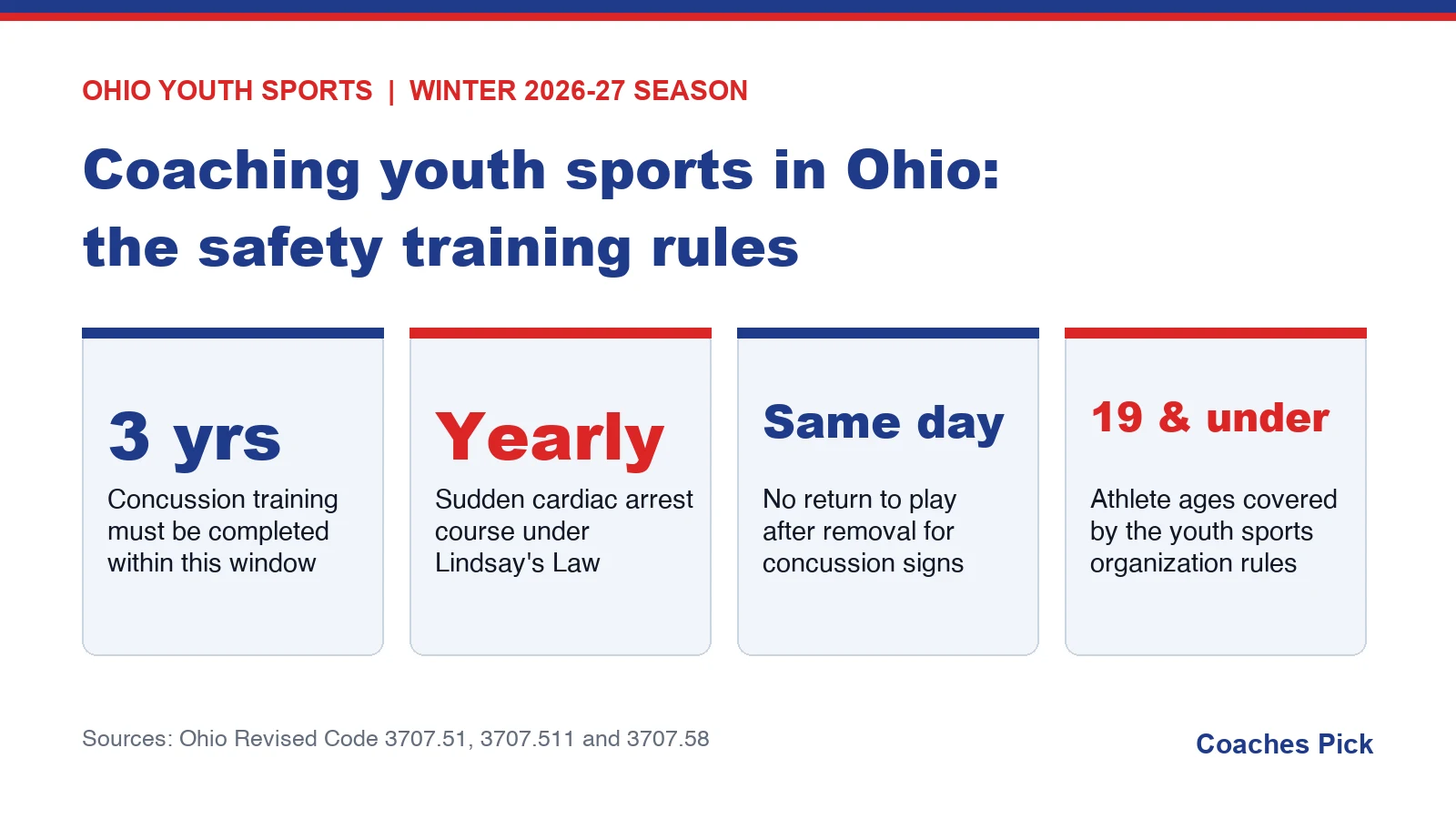
3 years
Concussion training window for coaches and referees
Every year
Lindsay's Law cardiac arrest course for coaches
19 & under
Athlete ages covered by the definition
Same day
No return after removal for concussion signs
What concussion training do Ohio youth coaches need?
Under Ohio Revised Code 3707.511, no one may act as a coach or referee for a youth sports organization unless they hold a pupil-activity program permit for coaching interscholastic athletics, or show they completed a concussion and head injury recognition program within the previous three years. The rule covers referees as well as coaches.
The training has to be one the Ohio Department of Health links on its website. Section 3707.52 requires the department to post links to one or more free online programs that fit coaches and referees of youth sports organizations. The law also puts the burden on the league: the organization must tell each prospective coach or referee about the requirement.
In practice, that means collecting a completion certificate from each volunteer and noting the completion date. Because the window is three years, a certificate a coach earned in early 2024 could lapse partway through a 2027 season. Track expiration dates, not just whether a certificate is on file.
What does Lindsay's Law require of youth coaches?
Lindsay's Law deals with sudden cardiac arrest. Ohio Revised Code 3707.58 says no one may coach an athletic activity organized by a youth sports organization unless they have completed, on an annual basis, the sudden cardiac arrest training course approved by the Ohio Department of Health. Unlike the concussion rule, this one is yearly.
Section 3707.59 directs the Department of Health to approve a sudden cardiac arrest course offered by an outside entity, and directs the health and education departments to post materials on warning signs such as fainting, difficulty breathing, chest pains, dizziness and an abnormal racing heart rate. Check the Department of Health's website for the currently approved course before assigning it to coaches.
| Requirement | Concussion law (ORC 3707.511) | Lindsay's Law (ORC 3707.58) |
|---|---|---|
| Coach training | Within the previous three years (referees too) | Every year |
| Family paperwork | Information sheet given to parents annually for each sport | Form signed by athlete and parent each calendar year |
| Preseason meeting | Not required by this section | Informational meeting before each season |
| Removal trigger | Signs, symptoms or behaviors consistent with a concussion | Fainting (syncope) |
| Who clears return | Physician or qualifying licensed health care professional, in writing | Physician (including a cardiologist), or a certified nurse practitioner, clinical nurse specialist or certified nurse-midwife, in writing |
What paperwork do families need to sign?
The two laws handle family paperwork differently. Under the concussion law, the league must give each parent or guardian the state's concussion and head injury information sheet annually for each sport or category of activity. Section 3707.511 requires the league to provide the sheet; it doesn't spell out a signature.
Lindsay's Law goes further. A youth athlete may not participate until the athlete and a parent or guardian sign and submit a form stating they've reviewed the state's sudden cardiac arrest information. A completed form must be submitted each calendar year to each youth sports organization. A form signed in September for fall soccer won't cover a player who registers for spring baseball in 2027.
Lindsay's Law also requires an informational meeting before the start of each athletic season, open to athletes, parents and others, on the symptoms and warning signs of sudden cardiac arrest. Many leagues fold it into a parent night or the first practice. Our first youth basketball practice plan shows one way to fit a short parent briefing into opening week.
When must a coach pull a player from a game?
Under the concussion law, a player who shows signs, symptoms or behaviors consistent with a concussion or head injury must be removed from the practice or game by the coach, a referee or a supervising league official. That person may not let the player return the same day.
To return later, the player must be assessed by a physician or a qualifying licensed health care professional and receive written clearance from the person who assessed them. Under Lindsay's Law, a coach must remove a player who faints, and the player can't return until cleared in writing by a physician, including a cardiologist, or by a certified nurse practitioner, clinical nurse specialist or certified nurse-midwife.
Lindsay's Law also bars a player from participating if a biological parent, sibling or child has had sudden cardiac arrest, until a physician clears them, or if the player is known to have fainted and hasn't been cleared. Leagues must set their own penalties for coaches who break the removal rules.
How can a league keep track of it all?
A simple spreadsheet works for most volunteer leagues. List every coach, assistant and referee with two dates: the concussion training completion date and the Lindsay's Law course date. Add a column for each player's signed Lindsay's Law form for the calendar year, and mark when the concussion information sheet went out.
- Before the season: collect both training certificates from every coach, and concussion certificates from referees.
- At registration: send the concussion information sheet and collect the signed Lindsay's Law form from each athlete and parent.
- Opening week: hold the sudden cardiac arrest informational meeting and record who attended.
- January 1: flag every player whose Lindsay's Law form was signed in 2026, since a new form is due for 2027.
- Every game: make sure the person in charge knows the removal rules and has the written clearance policy.
Hand the checklist from one volunteer to the next the same way you hand off the concession stand or field keys. Our volunteer shift handoff guide covers keeping one shared record, and the weather cancellation plan shows how to write game-day safety calls down before you need them.
Does following these laws protect the league?
Both sections include immunity language. They say a youth sports organization and its officials, employees, volunteers, coaches and referees aren't liable in damages for acts or omissions under those sections unless the conduct is willful or wanton misconduct. The laws also preserve any other immunity the organization already has.
That isn't a substitute for advice from the league's insurer or an attorney, and it doesn't cover a league that ignores the rules. The practical takeaway is simpler: keep the certificates, forms and clearance letters on file. If a question ever comes up, a dated record that every coach was trained and every family signed is the best answer a volunteer board can give.
Frequently asked questions
How often do Ohio youth coaches need concussion training?
Under Ohio Revised Code 3707.511, a coach or referee for a youth sports organization must show they completed a concussion and head injury training program within the previous three years, unless they hold a pupil-activity program permit for coaching interscholastic athletics. The training must be one the Ohio Department of Health links on its website.
Is Lindsay's Law training required every year?
Yes. Ohio Revised Code 3707.58 says no one may coach an athletic activity organized by a youth sports organization unless they have completed, on an annual basis, the sudden cardiac arrest training course approved by the Ohio Department of Health. That is a separate course from concussion training.
Which leagues count as youth sports organizations in Ohio?
Ohio Revised Code 3707.51 covers public or nonpublic entities that organize an athletic activity for athletes 19 or younger who pay a fee to participate, or whose participation cost is sponsored by a business or nonprofit. Most fee-based rec leagues, travel clubs and camps fit that description.
Who can clear a child to return after a suspected concussion?
The athlete can't return the same day. They need an assessment by a physician or a qualifying licensed health care professional, and written clearance from the person who assessed them, under Ohio Revised Code 3707.511. A coach or parent can't give that clearance.
What happens if a youth athlete faints during practice or a game?
Lindsay's Law requires the coach to remove a youth athlete who faints. The athlete can't return until cleared in writing by a physician, including a cardiologist, or by a certified nurse practitioner, clinical nurse specialist or certified nurse-midwife, under Ohio Revised Code 3707.58.
Need free youth league management software?
Coaches Pick is free for league owners. Registration, schedules, messaging, and portals for parents, coaches, referees, and kids — built for NFL FLAG and other youth sports programs that are adding teams.