League Operations
Youth Sports Sponsorship Rules: What Leagues Can Offer
Youth sports sponsorship money stays outside unrelated business income tax for a nonprofit league when the sponsor gets only its name, logo or product lines acknowledged. Advertising language, exclusive-provider deals and perks above 2% of the payment change that, and donations carry separate $75 and $250 receipt rules.
· Coaches Pick · 8 min read
Youth sports sponsorship money stays clear of unrelated business income tax for a tax-exempt league when the sponsor gets only its name, logo or product lines acknowledged, according to IRS Publication 598. A banner reading "Thanks to Main Street Hardware" fits that rule. Advertising language, exclusive-provider deals and thank-you perks worth more than 2% of the payment don't.
This guide walks through what a league can promise a sponsor, what turns a sponsorship into advertising, and how sponsorships differ from donations, which come with their own receipt rules. It's general education, not tax advice. A league with large or unusual deals should run its sponsor agreement past a CPA or tax attorney who works with nonprofits.
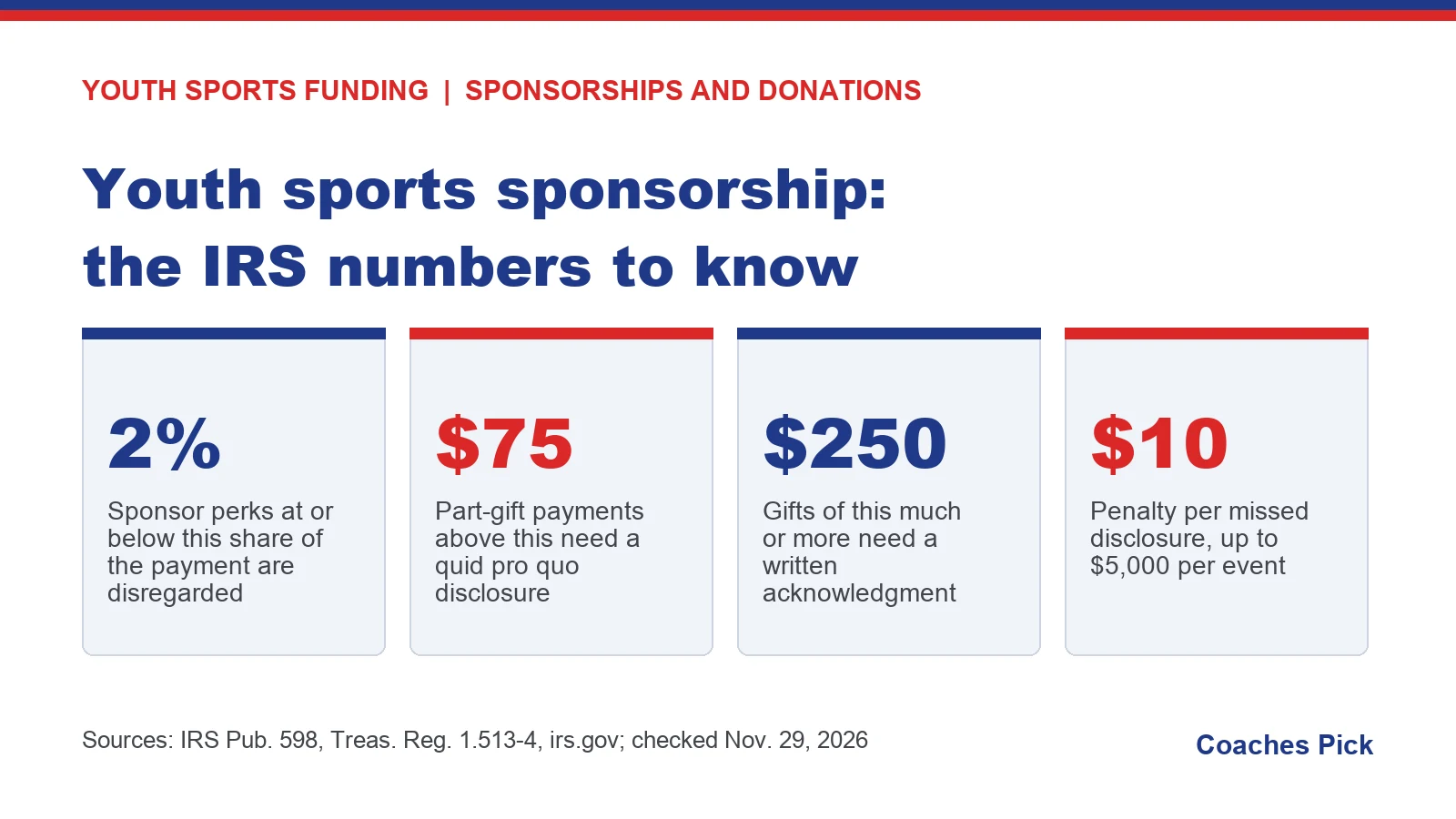
2%
Perk value limit, as a share of the payment
$75
Part-gift payment level that needs a disclosure
$250
Gift size that needs a written acknowledgment
$10
Penalty per missed disclosure, up to $5,000 per event
What is a qualified sponsorship payment?
Publication 598 defines a qualified sponsorship payment as a payment from a business that receives no substantial benefit other than "the use or acknowledgment" of its name, logo or product lines in connection with the organization's activities. Receiving these payments isn't an unrelated trade or business, so the league doesn't owe unrelated business income tax on them.
The rules apply to tax-exempt organizations, so they matter most to leagues organized as 501(c)(3) charities or other exempt nonprofits. If your league isn't exempt, every dollar of sponsor money is simply income, and the distinction below matters less than getting your organizational status right. Check your status before you print a single banner.
The IRS gives a simple example: if a league promises to use a sponsor's name or logo to acknowledge its support for a fundraising event, the payment qualifies. The Treasury regulation adds that acknowledgment can include exclusive sponsorship, the sponsor's locations, phone numbers or web address, and value-neutral descriptions of its product lines.
What turns a sponsor shout-out into advertising?
A payment isn't a qualified sponsorship payment if the league advertises the sponsor's products or services in return. Publication 598 lists three kinds of advertising: messages with qualitative or comparative language, price information or other indications of savings or value; endorsements; and inducements to purchase, sell or use the products or services.
| Usually acknowledgment | Usually advertising |
|---|---|
| "Thank you to Rivera Family Dental" | "The best dentist in town" |
| Sponsor logo and established slogan | "10% off for league families this week" |
| Sponsor's address, phone number and website | "Coach Mike recommends Rivera Dental" |
| "Proud sponsor of the 10U division" | "Stop by after the game and get a free cleaning" |
| Handing out the sponsor's water bottles at an event | "Cheaper than any other dentist in the county" |
Two details help leagues. Publication 598 says a promotional logo or slogan that is an established part of the sponsor's identity isn't, by itself, advertising. And simply handing out or displaying a sponsor's product at a sponsored event, free or for a price, counts as acknowledgment rather than advertising.
Mixed packages aren't all-or-nothing. If a payment buys both acknowledgment and product advertising, Publication 598 says unrelated business income tax doesn't apply to the part of the payment that is more than the fair market value of the advertising. That makes it worth pricing an advertising add-on separately in your sponsor packet.
Can a league offer an exclusive sponsorship?
Yes, with a limit. Under Treasury Regulation 1.513-4, acknowledging a business as the exclusive sponsor of an activity, or the exclusive sponsor from its industry, generally doesn't create a substantial return benefit. "The fall season is sponsored exclusively by Lakeside Credit Union" is fine on its own.
An exclusive provider deal is different. The regulation says an arrangement that limits the sale, distribution, availability or use of competing products in connection with the league's activity generally does create a substantial return benefit. Agreeing that only one soft-drink brand will be sold at the concession stand is the kind of promise that falls on that side of the line.
How much can sponsors get as a thank-you?
Leagues like to thank sponsors with tickets to a banquet, a framed team photo or a spot in a golf outing. The regulation disregards those benefits if their total fair market value for the year is not more than 2% of the payment. On a $1,000 sponsorship, the limit works out to $20.
Cross that line and the math changes sharply. The regulation says if the benefits exceed 2%, the entire fair market value of the benefits, not just the excess, is a substantial return benefit. Publication 598 adds that tickets, receptions and similar privileges are treated as a separate transaction when deciding whether the league has unrelated business income.
- Keep a simple sponsor log: amount paid, what you promised, and what you actually delivered.
- Put a dollar value on every perk, using what the public would pay for it.
- Total the perks for each sponsor once a year and compare them with 2% of what that sponsor paid.
- If a sponsor wants bigger perks, price them as a separate purchase rather than folding them into the sponsorship.
Are there sponsorship deals that don't qualify?
Publication 598 lists a few exceptions. A payment doesn't qualify if its amount depends on attendance, broadcast ratings or other measures of public exposure, though a payment contingent only on the event taking place is fine. Payments tied to a qualified convention or trade show don't qualify, and neither do payments for recognition in the league's periodical.
That periodical rule matters for leagues that publish a regular newsletter or magazine. Publication 598 defines a periodical as regularly scheduled printed material, such as a monthly journal. It doesn't include material related to and mainly distributed at a specific event, like a tournament program. So a sponsor page in your championship-day program is treated differently from a standing ad in a monthly newsletter.
How are sponsorships different from donations?
A parent who writes a check to the league and asks for nothing back is making a donation, and donation rules apply. The IRS written acknowledgment page says a donor needs a written acknowledgment from the charity to substantiate a contribution of $250 or more. The acknowledgment must include the organization's name and the cash amount, or a description, but not the value, of a non-cash gift.
It must also say whether the league provided any goods or services in return, and if it did, describe them and give a good-faith estimate of their value. Many leagues send one year-end letter to every donor, which covers the $250 rule and gives families a clean record. Our GivingTuesday fundraiser guide shows how to build that thank-you step into a campaign.
Fundraisers that give something back trigger a second rule. The IRS quid pro quo page says when a donor pays more than $75 partly as a gift and partly for goods or services, the charity must give a written disclosure. It must tell the donor that only the amount above the value received is deductible and give a good-faith estimate of that value.
The penalty for skipping it is $10 per contribution, up to $5,000 per fundraising event or mailing, unless the league shows reasonable cause. A $100 banquet ticket that includes a $40 dinner needs a disclosure, even though the deductible part is only $60. IRS Publication 1771 covers both rules in more detail.
What should a youth league sponsor packet include?
A clear packet keeps sponsors happy and keeps the league on the acknowledgment side of the line. Build each level around recognition, list any perks with their value, and keep advertising, if you sell it at all, as a separately priced add-on with its own line on the invoice.
- Sponsor levels by recognition: name on the website sponsor list, logo on a field banner, logo on jerseys, naming of a division or tournament.
- A short list of perks with a fair market value next to each, so you can check the 2% limit.
- Language rules for banners and PA reads: names, logos, established slogans, addresses and web links, but no prices, discounts or "best in town" claims.
- No promises about attendance numbers or tying the price to crowd size.
- A note on exclusivity: exclusive sponsor is fine, exclusive provider needs a closer look.
- A written receipt for every sponsor and a year-end acknowledgment for every donor of $250 or more.
Sponsor money pairs well with other funding. Leagues that need gear can apply for donated equipment, as our free sports equipment guide explains, and sponsor dollars can underwrite fee help for families, which our registration assistance guide covers. For field projects, a capital grant like the one in our NFL Foundation Grassroots guide is a better fit than a banner program.
Frequently asked questions
Is youth sports sponsorship money taxable for a nonprofit league?
Under IRS Publication 598, a qualified sponsorship payment isn't unrelated business income and isn't subject to unrelated business income tax. It qualifies when the sponsor gets no substantial benefit beyond use or acknowledgment of its name, logo or product lines. Advertising or other substantial perks can make part of a payment taxable.
Can a sponsor banner include a slogan or a discount?
A slogan or logo that is an established part of the sponsor's identity isn't, by itself, advertising, according to Publication 598. Price information, discounts, comparative claims like "best pizza in town," endorsements and calls to buy are advertising, so keep those off acknowledgment banners and shout-outs.
Can a league give a sponsor exclusive rights?
Naming a business the exclusive sponsor generally doesn't create a substantial return benefit under Treasury Regulation 1.513-4. Agreeing to sell or allow only that sponsor's products, such as one drink brand at the concession stand, is an exclusive provider arrangement and generally does create one.
What can a league give sponsors as a thank-you?
Perks such as event tickets or a team photo are disregarded if their total fair market value for the year is 2% of the payment or less. On a $1,000 sponsorship, that's $20. Above 2%, the full value of the perks, not just the excess, counts as a substantial return benefit.
Does a league need to send donors receipts?
A donor needs a written acknowledgment from the charity to substantiate a contribution of $250 or more. If a donor pays more than $75 and gets something back, like a banquet ticket that includes dinner, the charity must give a written disclosure with a good-faith estimate of what the donor received.
Need free youth league management software?
Coaches Pick is free for league owners. Registration, schedules, messaging, and portals for parents, coaches, referees, and kids — built for NFL FLAG and other youth sports programs that are adding teams.