League Operations
GivingTuesday Fundraiser for Youth Sports: A League Plan
A GivingTuesday fundraiser for youth sports works best as a short, single-goal campaign. GivingTuesday falls on December 1, 2026, so leagues have a few days to pick one need, line up volunteers and set up donor receipts that meet IRS rules for gifts of $250 or more.
· Coaches Pick · 6 min read
A GivingTuesday fundraiser for youth sports works best as a short campaign with one clear goal. GivingTuesday falls on December 1, 2026, so leagues have a few days to pick one need, line up volunteers and set up donor receipts that meet IRS rules for gifts of $250 or more.
When is GivingTuesday 2026?
GivingTuesday is Tuesday, December 1, 2026, according to GivingTuesday.org. It falls on the Tuesday after Thanksgiving every year. For a youth league, that timing sits between fall seasons ending and winter or spring registration opening, when families are already thinking about next season's costs.
The short runway is a feature, not a problem. A one-day campaign asks volunteers for a burst of effort instead of a month of reminders. Plan the work now: Friday and Saturday for setup, Sunday and Monday for previews to families, Tuesday for the main push, and Wednesday for thank-yous and the final total.
Dec. 1
GivingTuesday 2026
$250
Single gift that needs a written acknowledgment
$75+
Part-gift payment that needs a disclosure
$1,000
2026 non-itemizer cash deduction ($2,000 joint)
What should a youth league raise money for?
Pick one concrete need that families can picture. Good GivingTuesday goals include registration scholarships, a set of goals or nets, replacement helmets, catcher's gear, field paint or referee fees for a spring season. A single named goal with a dollar figure gives volunteers one sentence to repeat and donors one reason to give.
Scholarship funds are often the easiest story to tell, because every family understands the cost of a registration fee. If your league already offers fee help, our registration assistance guide explains how leagues structure it. Name the per-player cost so donors can see what their gift covers, such as one season for one player.
- One goal, one dollar figure and one deadline: midnight on December 1.
- A breakdown donors can picture, such as the cost of one player's season or one set of gear.
- A named person who answers donor questions and sends receipts.
- A plan for money raised beyond the goal, stated up front.
Can donors deduct gifts to a youth league?
Only if the league is a qualified charitable organization or gives through one. Many leagues are 501(c)(3) charities, but some are informal clubs, booster groups or other nonprofit types. Check the league's status, and the name it appears under, in the IRS Tax Exempt Organization Search before any post calls a gift tax-deductible.
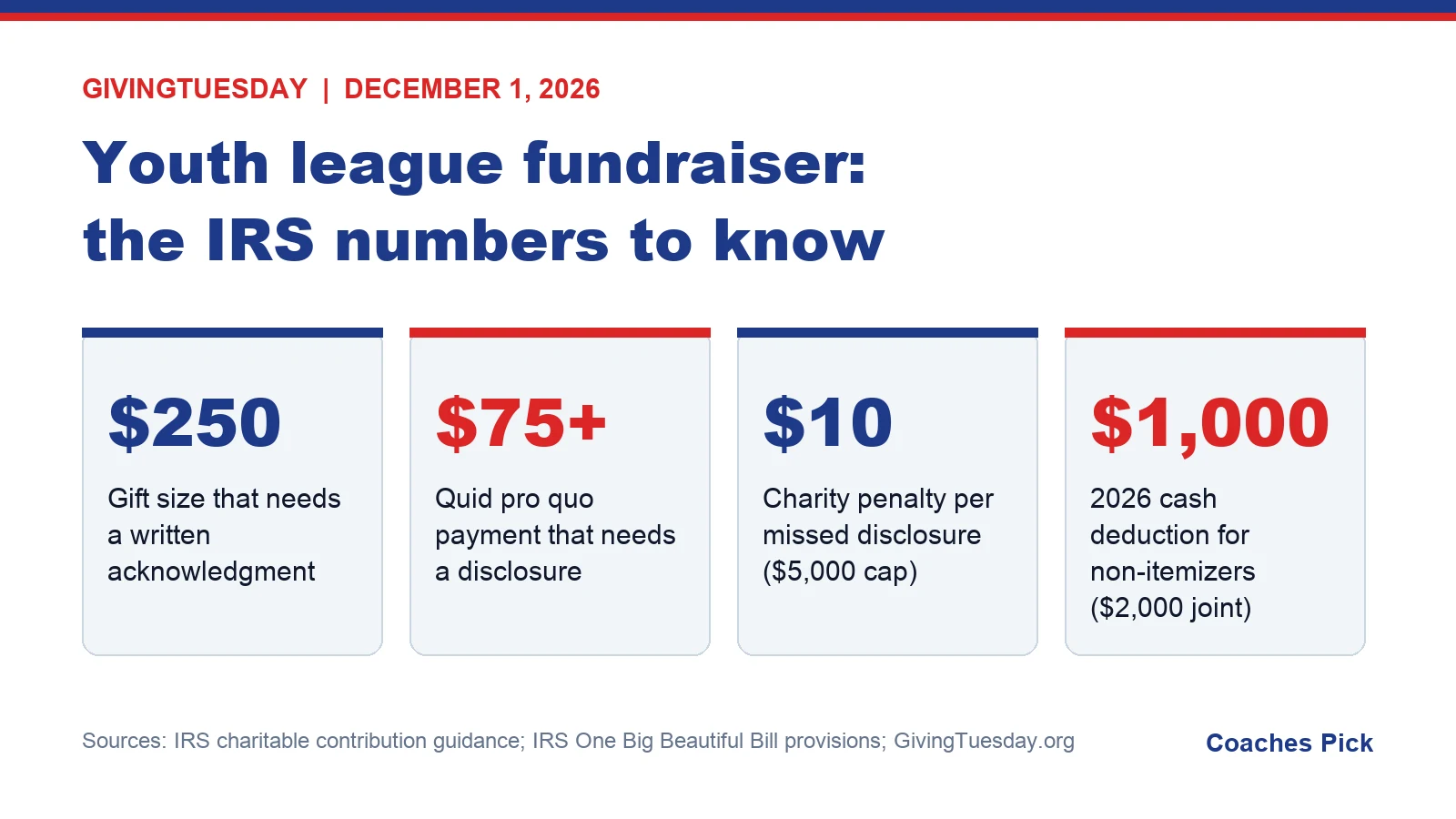
If the league does qualify, there is a timely 2026 change. The IRS One Big Beautiful Bill provisions page says that starting with tax year 2026, people who don't itemize can deduct up to $1,000 in cash gifts to eligible charities, or $2,000 for married couples filing jointly. Gifts to donor-advised funds don't count toward it.
Mention the rule plainly and point donors to the IRS page or their own tax professional. A league shouldn't promise any donor a specific tax result, because deductibility depends on each household's return. Stick to facts the league controls: its legal name, its tax status and the amount and date of each gift.
What does a donor receipt need to say?
For any single gift of $250 or more, the donor needs a written acknowledgment from the charity. The IRS written acknowledgment page lists what it must include: the organization's name, the cash amount, a description but not a value of any non-cash gift, and whether the league gave anything in return.
If the league gave nothing back, the receipt should say so in plain words. If it gave something, the receipt needs a description and a good-faith estimate of that item's value. Most online giving platforms send automatic receipts, but check that the template includes the league's legal name and the no-goods-or-services line.
| Situation | What the league provides |
|---|---|
| Single gift of $250 or more | Written acknowledgment with league name, amount, and whether anything was given in return |
| Payment over $75 that includes goods or services | Written disclosure that the deduction is limited to the amount over the item's value, plus a good-faith estimate of that value |
| Non-cash gift, such as used equipment | Description of the item in the acknowledgment, but no value |
| Gift with nothing given in return | A statement that no goods or services were provided |
What if donors get a shirt, ticket or other thank-you gift?
Thank-you items change the paperwork. The IRS quid pro quo page says that when a payment over $75 is partly a gift and partly for goods or services, the charity must give a written disclosure. It tells donors the deductible amount is limited to what they paid beyond the item's value.
The disclosure must also give a good-faith estimate of that value. The penalty for skipping it is $10 per contribution, up to $5,000 per fundraising event or mailing, unless the charity shows reasonable cause. The IRS lists exceptions for items of insubstantial value, so a sticker or magnet usually raises fewer questions than a hoodie or dinner ticket.
The simplest path for a one-day campaign is to keep thank-you gifts out of it. Offer a public thank-you post or a name on a season banner instead. If the league does sell shirts or event tickets, list the item's fair market value on the giving page and in the receipt, so donors see the deductible portion.
How do you run the campaign on the day?
Treat December 1 like a game day with a written schedule. Post the goal and giving link in the morning, share a progress update at lunch, send a coach or player story in the afternoon, and post a final push in the evening. Give each post to a named volunteer so nobody is guessing who sends what.
Keep messages short and easy to forward. Our group text guide covers wording that parents actually read on a phone. Ask each coach to share the link once with their team's families, and ask board members to send it to five personal contacts, rather than asking everyone to post everywhere.
If several volunteers handle the giving page, receipts and social posts across the day, write down who covers which hours. The same handoff habits from our volunteer shift handoff guide apply: one shared note, the current total and any donor questions still open.
What should happen after GivingTuesday?
Thank donors within a day or two and report the final total, even if the league missed its goal. Then show the money at work: post a photo when the new nets arrive or share how many players the scholarship fund covered. That follow-up is what makes families willing to give again next year.
Finish the paperwork while it's fresh. Confirm every gift of $250 or more has a written acknowledgment, file copies of the receipts and any value disclosures with the league's records, and note what worked for next year's volunteers. A short record of the goal, the posts, the timing and the total saves the next board a lot of guesswork.
Frequently asked questions
When is GivingTuesday 2026?
GivingTuesday is Tuesday, December 1, 2026, according to GivingTuesday.org. It always falls on the Tuesday after U.S. Thanksgiving, so a league that starts planning over the holiday weekend still has a few days to set a goal, write its posts and test its donation page before launch.
Can any youth league collect tax-deductible donations?
No. Gifts are generally deductible only when the league is a qualified charitable organization, such as a 501(c)(3), or gives through one. Many volunteer leagues are informal clubs or other nonprofit types. Confirm the league's status before any post or receipt calls a gift tax-deductible.
Does a league have to send a receipt for every donation?
The IRS requires a donor to have a written acknowledgment from the charity for any single contribution of $250 or more. Smaller gifts still need a bank record or written record from the charity. Sending every donor a receipt with the league's name, date and amount is the simplest practice.
What if donors get a T-shirt or event ticket?
When a payment over $75 is partly a gift and partly for goods or services, the IRS requires a written disclosure. It must say the deductible amount is limited to the payment minus the value received, and give a good-faith estimate of that value. Missing it can cost $10 per contribution.
Can donors who don't itemize deduct their gift in 2026?
The IRS says that starting with tax year 2026, people who don't itemize can deduct up to $1,000 in cash gifts to eligible charities, or $2,000 for married couples filing jointly. Leagues can mention the rule, but should point donors to the IRS or a tax professional for their own situation.
Need free youth league management software?
Coaches Pick is free for league owners. Registration, schedules, messaging, and portals for parents, coaches, referees, and kids — built for NFL FLAG and other youth sports programs that are adding teams.